Counterspell MTG Card Guide: Two Blue Mana, No Questions Asked
Prices from cards tracked on RareWell — updated daily. Last updated September 23, 2026. Format legality changes — verify against the current official banned & restricted list.
Counterspell is a blue instant that costs two blue mana and counters any target spell. It is the baseline against which nearly every later counterspell is measured: simple, unconditional, efficient, and powerful enough that many formats use weaker versions instead.
The original Counterspell has only three words of rules text that matter: counter target spell. There is no extra payment, no restriction on card type, and no delayed drawback. If the spell is a legal target and Counterspell resolves, that spell does not resolve.
Its simplicity made it one of the defining cards of early Magic and one of the clearest expressions of blue’s identity. Blue does not need to destroy the permanent after it arrives if it can stop the spell from becoming a permanent in the first place.
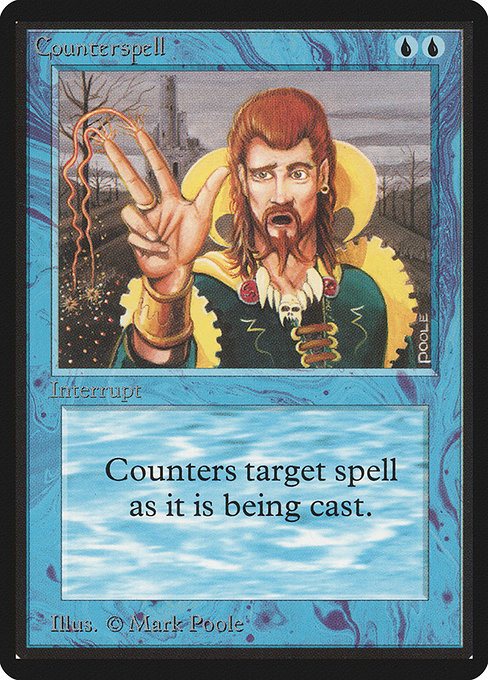
What happens when a spell is countered
When a player casts a spell, it goes onto the stack. Counterspell targets that spell. If Counterspell resolves while the target is still legal, the target spell is put into its owner’s graveyard without resolving.
A countered creature does not enter the battlefield. Its enter-the-battlefield ability does not trigger. A countered sorcery does not perform any of its instructions. The mana and other costs used to cast the countered spell are not refunded.
Counterspell cannot normally target an ability. It targets a spell. Cards designed to counter activated or triggered abilities use different wording.
Why two blue mana matters
Counterspell is efficient, but its cost is demanding. Two blue symbols mean the player must keep two blue sources available. That encourages decks with a strong blue base and makes splashing Counterspell more difficult than splashing a card that costs one blue and one generic mana.
The cost also creates table tension. Two untapped Islands can represent Counterspell even when the player does not have it. That possibility changes how opponents sequence their spells, which threats they lead with, and whether they wait for protection.
Later designs often add restrictions or higher costs: counter only a noncreature spell, make the opponent pay extra mana, or cost three mana for an unconditional answer. Those variants help balance formats where the original rate would be too efficient.
Counterspell across Magic formats
Counterspell’s legality has changed as it has entered newer card pools through reprints. Check the current official format legality lists — legality can change.
The broader lesson is that “Counterspell is legal in Magic” is not a complete answer. Magic is a family of formats. A card can be central in one, absent from another, and legal but underplayed in a third.
Commander players often use Counterspell because it is efficient and flexible, though multiplayer decks may prefer counters that create additional value or handle more than one opponent’s plans.
The collectible versions
Counterspell has an unusually deep printing history. Collectors may focus on:
Starter 2000 is especially instructive. The card name is common and heavily reprinted, but the product was scarce. A printing’s value comes from the supply of that printing, not merely the supply of all cards named Counterspell.
- Alpha and Beta copies
- Other early black-border versions
- Starter 2000, a scarce beginner-product printing
- Old-border foils
- Promos and alternate artwork
- Modern premium treatments
- Artist- or theme-specific copies
Counterspell as a collection theme
A Counterspell page can become a miniature history of blue design. Showcase it beside Mana Drain, Force of Will, Daze, Spell Pierce, Cryptic Command, and Negate. The progression shows how Wizards has adjusted cost, tempo, card advantage, and restrictions across different eras.
Counterspell printings tracked on RareWell
| Card | Set | Rarity | Price |
|---|---|---|---|
| Counterspell | Limited Edition Beta | uncommon | $920 |
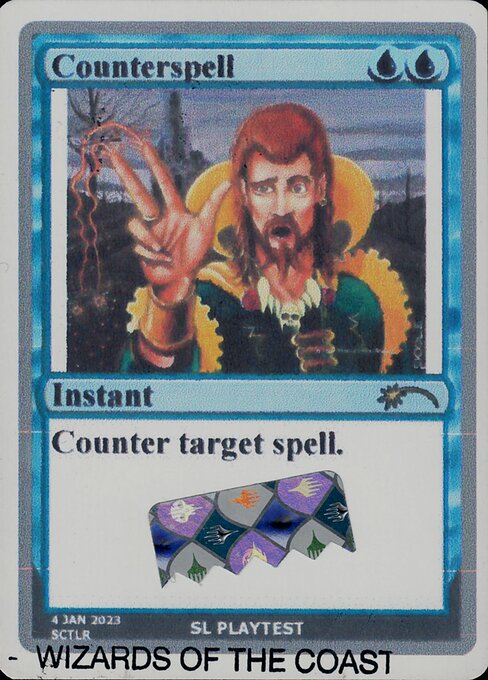 Counterspell Counterspell | Secret Lair Drop | rare | $900 |
 Counterspell Counterspell | Secret Lair Drop | rare | $369 |
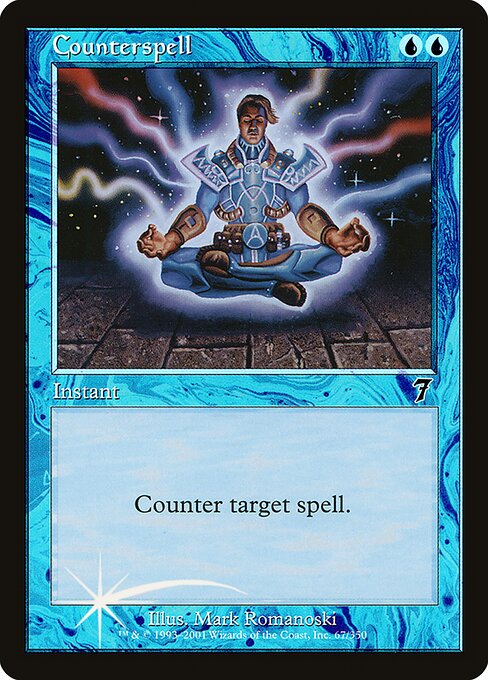 Counterspell Counterspell | Seventh Edition | common | $155 |
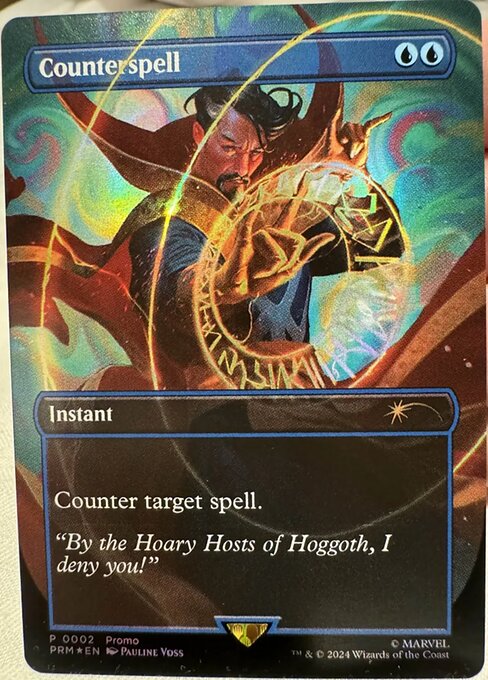 Counterspell Counterspell | URL/Convention Promos | rare | $92 |
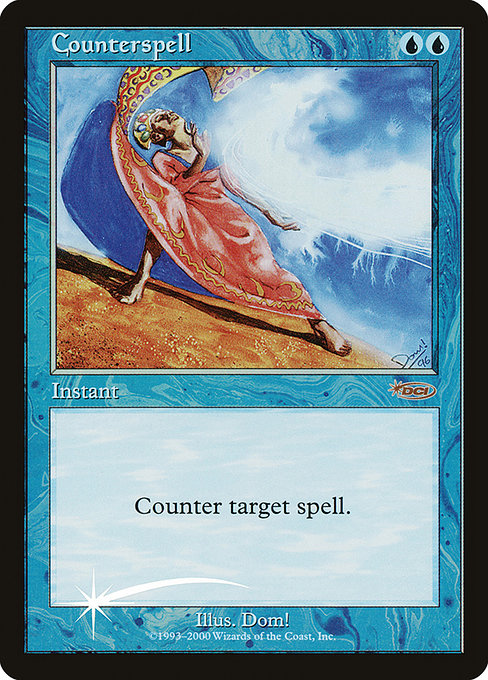 Counterspell Counterspell | Judge Gift Cards 2000 | rare | $78 |
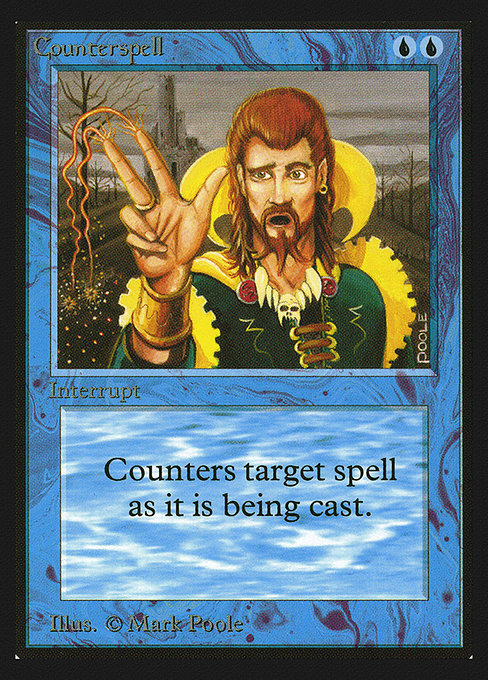 Counterspell Counterspell | Collectors' Edition | uncommon | $62 |
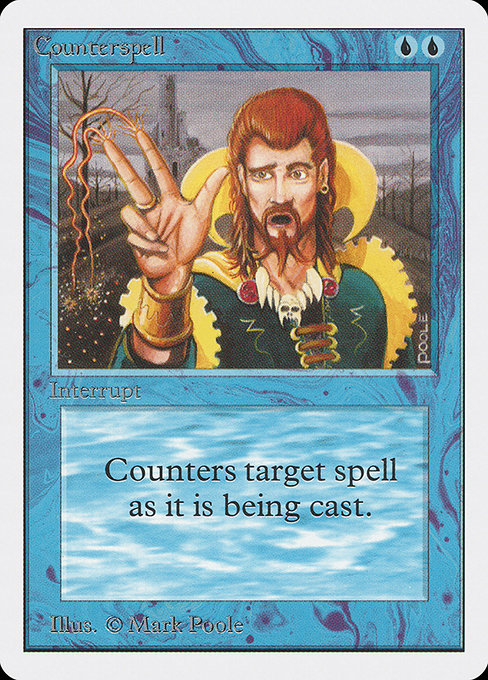 Counterspell Counterspell | Unlimited Edition | uncommon | $60 |
Collections featuring Counterspell
2 public collectors have this card on RareWell — tap through to see it in their collection.
Cards mentioned in this guide
Frequently asked questions
- Can Counterspell counter a creature?
- Yes, while the creature is still a spell on the stack. Once it resolves and enters the battlefield, Counterspell cannot target it.
- Does a countered spell go back to its owner’s hand?
- Normally no. A spell countered by Counterspell goes to its owner’s graveyard.
- Can Counterspell counter an ability?
- No. It targets a spell, not an activated or triggered ability.
- Why does Counterspell cost two blue instead of one blue and one generic?
- The demanding color cost limits which decks can cast it reliably and reinforces its identity as a strongly blue card.
- Which Counterspell printing is worth the most?
- Check the live printings table for current market data. In general, the oldest and scarcest printings and scarce premium copies command the strongest premiums.