Chaos Orb and Falling Star: Magic's Dexterity Cards Explained
Prices from cards tracked on RareWell — updated daily. Last updated September 23, 2026. Format legality changes — verify against the current official banned & restricted list.
Chaos Orb is an early Magic artifact that asks its controller to flip the physical card onto the playing area and destroy the cards it lands on. Falling Star applies a similar dexterity idea to creatures. Both are banned in normal sanctioned formats because outcomes depend on physical execution and table layout rather than only the game state.
Modern Magic assumes cards remain in their zones and effects resolve through rules. Chaos Orb comes from a stranger beginning, when the game was still experimenting with the physical card as part of play.
The result is one of Magic's greatest stories: a card valuable enough to protect, powerful enough to fear, and written to be tossed through the air.
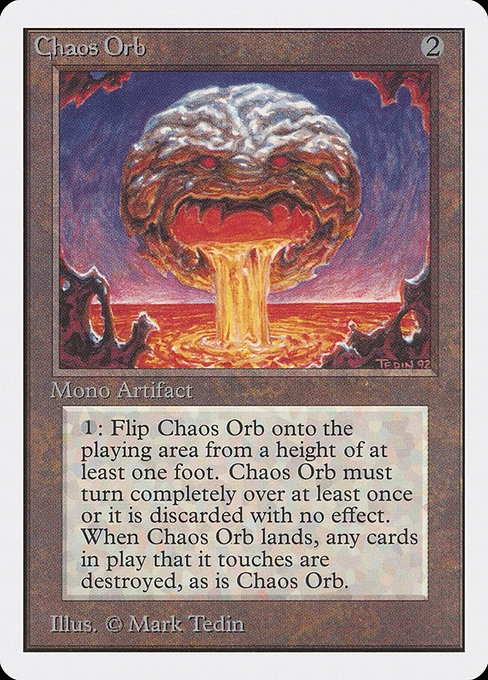
How Chaos Orb works
Chaos Orb's original text has been updated over time, but the core action remains physical. The player places the Orb above the playing area, flips it, and checks what it touches after landing under the applicable rules.
That creates questions ordinary Magic avoids. How high is high enough? What counts as a complete flip? Can players spread their cards apart? What happens on a small table? Those questions demonstrate why dexterity mechanics are difficult to support in competitive play.
There is no need to risk a valuable original card to appreciate the concept. A proxy in a consenting casual game is the sensible way to experience the joke.
The famous torn-card story
The best-known Chaos Orb legend says a player tore the card into pieces and scattered them over the opponent's battlefield so that a piece would touch everything.
The story is central to Magic folklore and inspired Chaos Confetti, the Unglued card that explicitly instructs the player to tear it up and throw the pieces. Accounts and details have been retold in different forms, so treat it as the famous tournament legend rather than a perfectly documented event.
The important historical fact is the legacy: Magic eventually wrote the destructive interpretation into a parody card.
Falling Star
Falling Star is a red sorcery built around a similar physical action. Instead of broadly threatening permanents, it interacts with creatures according to where the flipped card lands.
It is less famous than Chaos Orb, but it completes the tiny family of original ante-era dexterity oddities. Collectors often discuss the two together because both represent a design path Magic abandoned.
Why dexterity cards are banned
Dexterity cards create inconsistent outcomes based on physical ability, card sleeves, table dimensions, spacing, accessibility, and tournament logistics. They can also encourage players to arrange the battlefield in awkward ways that have nothing to do with strategic readability.
That does not make them bad collectibles. It makes them artifacts from a period when Magic's designers were still discovering what kind of game Magic would become.
Check the current banned-and-restricted list for exact format legality — it can change — but the stable collector takeaway is that these cards are not normal sanctioned-play staples.
Reserved List and collector appeal
Chaos Orb and Falling Star are historically important early cards and part of the Reserved List conversation. Edition, authenticity, and condition drive value. The oldest black-border copies are distinct from later white-border copies, and all should be labeled precisely.
Damage can be especially ironic here. A card famous for being flipped — or allegedly torn — may have scratches, dents, or edge wear from actual play. Those flaws affect value even when they add story.
Playing with dexterity cards today
Use a proxy, establish the procedure before the game, and make sure every player wants the experience. Do not flip a valuable vintage card onto a table. The goal is to enjoy a piece of Magic history, not create a new condition problem.
Chaos Orb printings tracked on RareWell
| Card | Set | Rarity | Price |
|---|---|---|---|
| Chaos Orb | Unlimited Edition | rare | $1,175 |
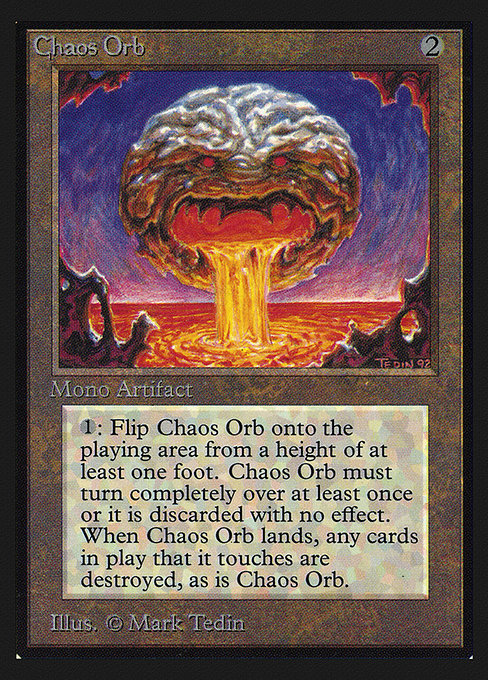 Chaos Orb Chaos Orb | Collectors' Edition | rare | $445 |
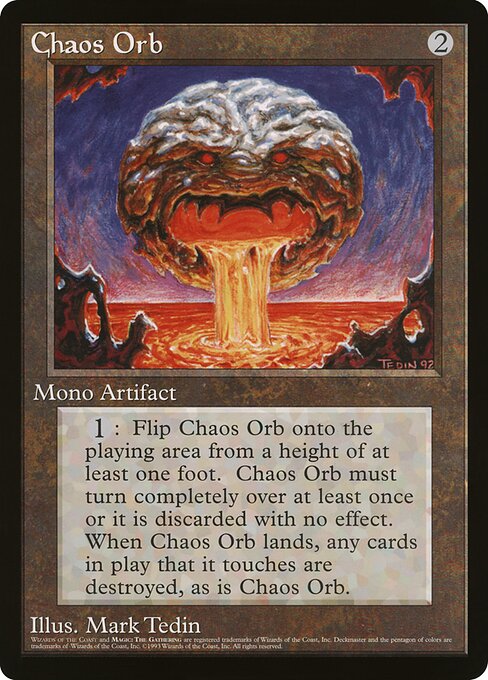 Chaos Orb Chaos Orb | Oversized 90's Promos | rare | — |
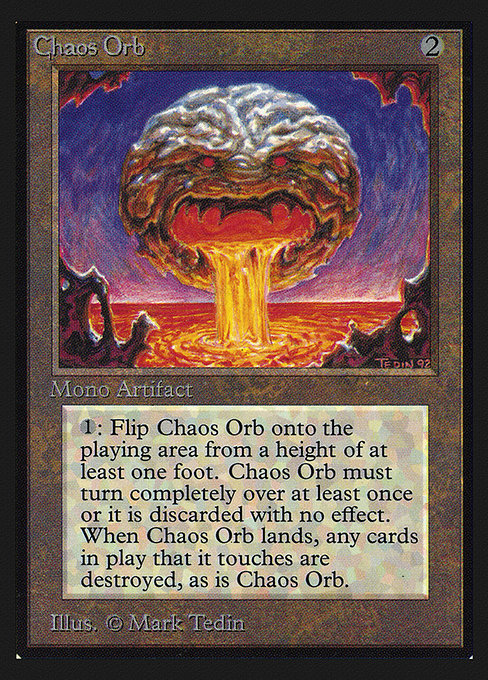 Chaos Orb Chaos Orb | Intl. Collectors' Edition | rare | — |
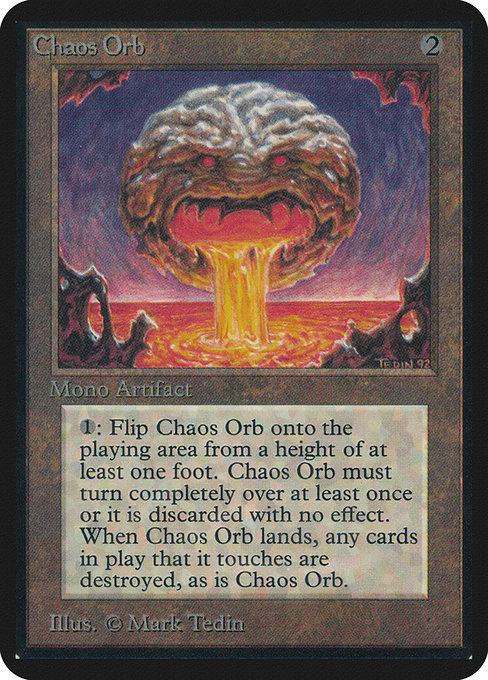 Chaos Orb Chaos Orb | Limited Edition Alpha | rare | — |
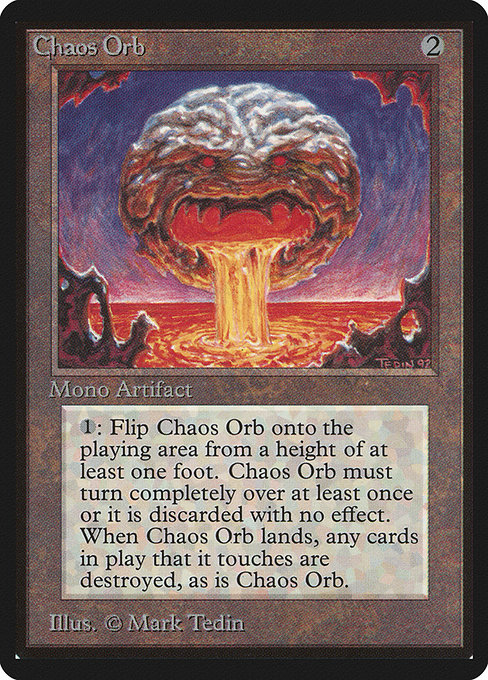 Chaos Orb Chaos Orb | Limited Edition Beta | rare | — |
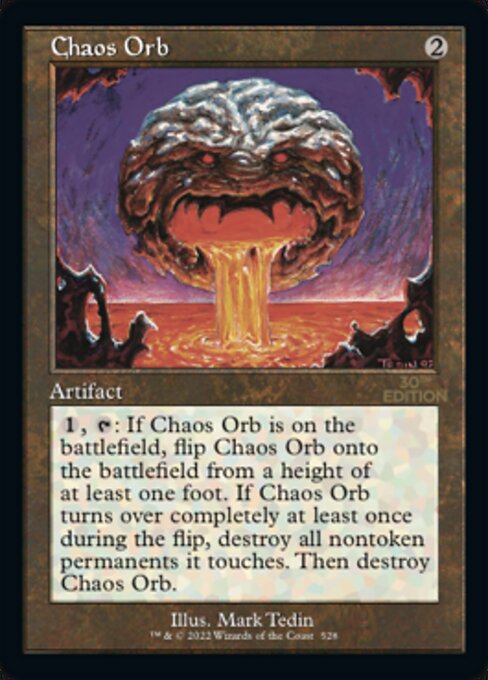 Chaos Orb Chaos Orb | 30th Anniversary Edition | rare | — |
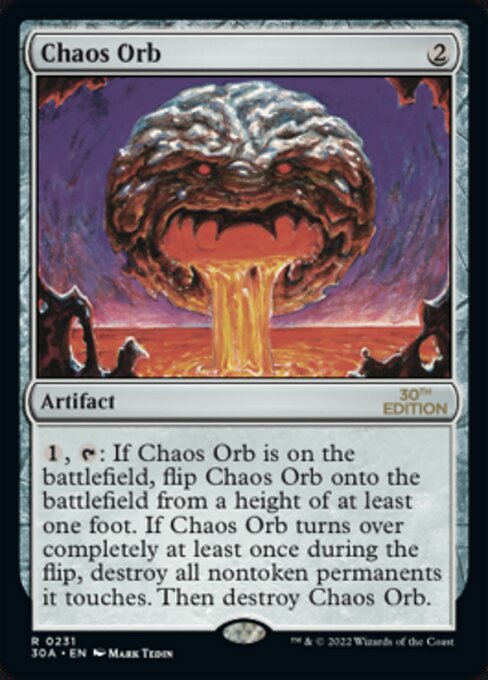 Chaos Orb Chaos Orb | 30th Anniversary Edition | rare | — |
Frequently asked questions
- Is Chaos Orb banned?
- It is banned in normal sanctioned formats where it would otherwise enter the card pool. Check the current banned-and-restricted list — format legality changes.
- Did a player really tear up a Chaos Orb?
- A famous tournament legend says so, and the story directly inspired Chaos Confetti. Retellings vary in detail.
- How high do you flip Chaos Orb?
- Historical text and rulings specify a physical procedure, but casual groups should agree on a safe proxy-based method before play.
- What is Falling Star?
- It is another early dexterity card, a red sorcery that uses a physical flip to affect creatures.
- Should I play with a real Chaos Orb?
- No collector needs to risk an expensive vintage card. Use a clearly marked proxy in a consenting casual game.