Chaos Confetti Card Guide: Magic's Torn-Up Legend
Prices from cards tracked on RareWell — updated daily. Last updated September 23, 2026. Format legality changes — verify against the current official banned & restricted list.
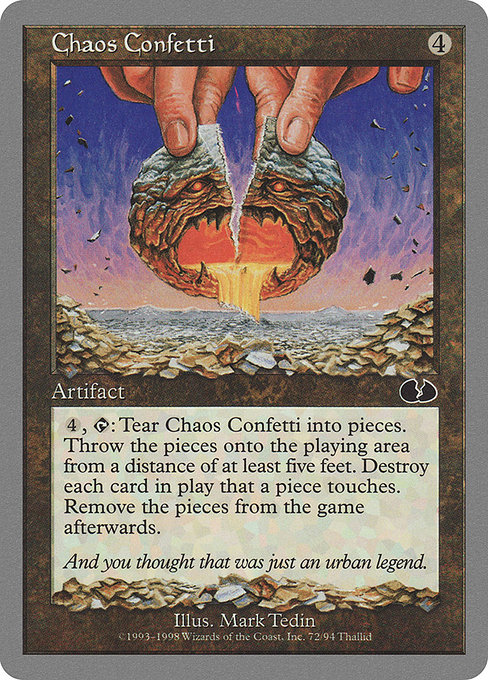
Chaos Confetti is an Unglued artifact you activate by tearing the card into pieces and throwing them onto the table — every nontoken permanent a piece lands on is destroyed, and your copy of the card is gone for good.
It exists to immortalize the most famous story in Magic history: the tournament player who supposedly ripped up his Chaos Orb and sprinkled it over his opponent's entire board.
What the Card Does
Chaos Confetti's activation is the whole show: tear the card into pieces, throw them onto the playing area from a distance, and destroy each nontoken permanent a piece touches. It is a one-shot board wipe whose blast radius depends entirely on your confetti-scattering technique.
Like all Unglued cards it is silver-bordered and was never tournament legal — fitting, since the card it parodies got banned from sanctioned play precisely because physical dexterity had no business deciding matches.
The Chaos Orb Legend
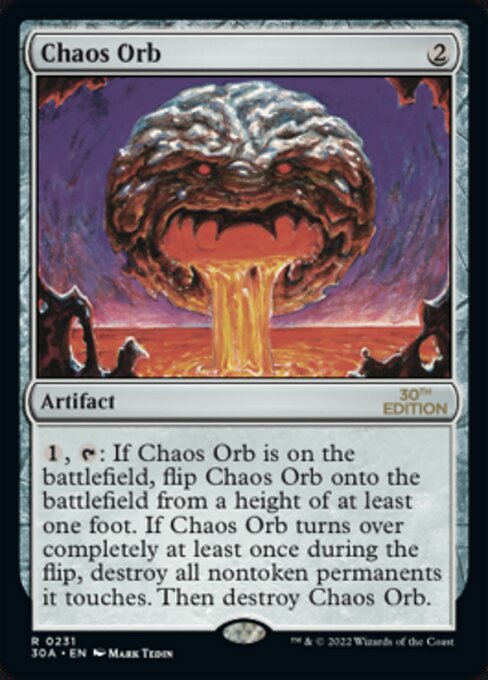
Chaos Orb, from Magic's original 1993 core set, required you to flip the card onto the table from at least a foot in the air, destroying whatever it landed on. Somewhere in the game's early tournament days, a story took hold: facing a developed board, a player tore his Chaos Orb into pieces and scattered them across everything his opponent controlled, arguing each piece was still Chaos Orb.
The tale usually ends with the player winning the argument but getting disqualified because his deck was now below the minimum card count. No one has ever verified it happened — it is Magic's great urban legend — but it was retold so widely that R&D canonized it in 1998 by printing Chaos Confetti, a card that makes the stunt the actual rules text.
Why Collectors Want It
Chaos Confetti is a story you can put in a binder. Alongside Blacker Lotus, it is one of the two famous 'destroy the card to use it' designs from Unglued, and the pair are frequently collected together as bookends of the set's self-destructive humor.
It also pairs naturally with Chaos Orb itself. Owning the legend and the punchline side by side — the dexterity card that started it all and the parody that enshrined the story — is one of the more satisfying small displays in vintage-adjacent collecting.
Collecting Notes
There is a single printing: Unglued, 1998, with no foil version since the set predates foil boosters. As with Blacker Lotus, an unknown number of copies were actually torn and thrown over the years, which quietly trims the surviving supply.
It has historically been one of the more affordable famous un-cards, making it an easy pickup for a jokes-and-legends page in a collection. Watch the silver border for wear, and be suspicious of taped-together copies being passed off as playable.
- Only printing: Unglued (1998), silver border, no foil
- Parody of Chaos Orb, banned long ago from sanctioned formats
- Torn copies have permanently left the supply
- Displays well alongside Blacker Lotus and Chaos Orb
Chaos Confetti printings tracked on RareWell
Collections featuring Chaos Confetti
1 public collector has this card on RareWell — tap through to see it in their collection.
Cards mentioned in this guide
Frequently asked questions
- Did the Chaos Orb tearing story really happen?
- There is no verified account — it is Magic's most enduring urban legend. Its cultural weight is real, though: Wizards printed Chaos Confetti in Unglued specifically as a nod to the tale.
- Is Chaos Confetti legal in any format?
- No. It is a silver-bordered Unglued card, so it has never been legal in sanctioned play. Casual groups sometimes allow it under rule zero, torn pieces and all.
- Should I actually tear my Chaos Confetti?
- That is the intended way to play it, but collectors generally keep copies intact — every torn copy makes the survivors a little scarcer. If you want the experience, use a cheap played copy, not a crisp one.